Tripod Vibration Damping: Stability Physics Explained
By Asha Menon • 29th Oct
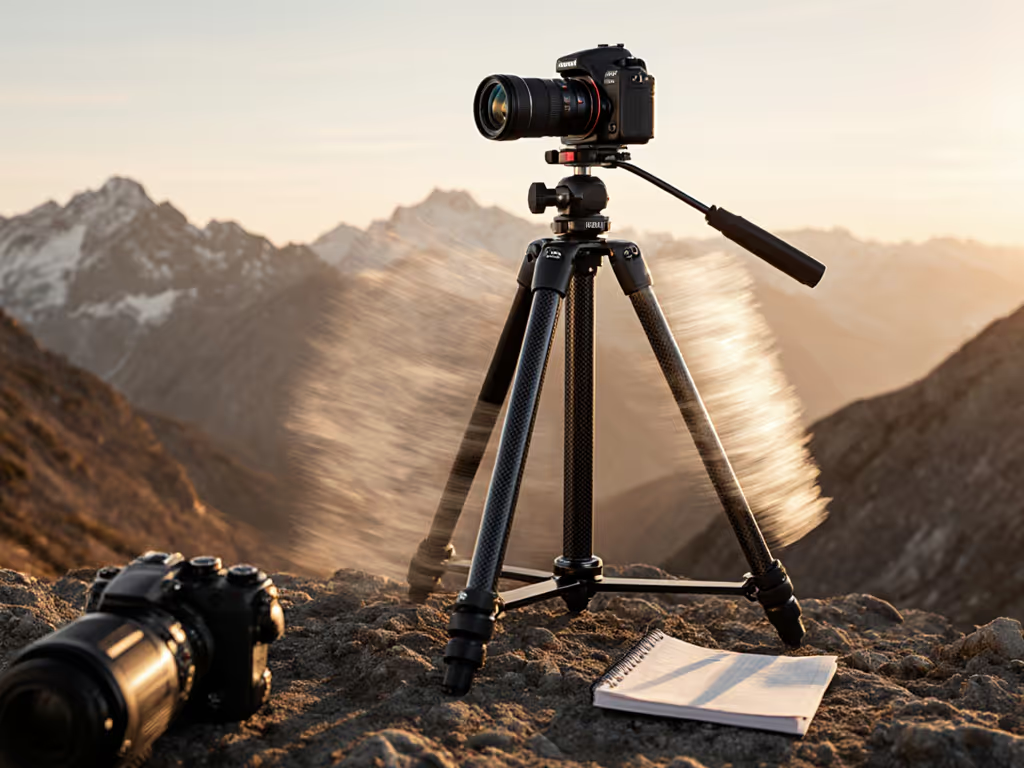
If your tripod wobbles at true height in wind, its load rating is meaningless. Period. That's the hard truth behind tripod vibration damping, the unsung physics of stability separating sharp images from wasted shots. Forget glossy specs. What matters is how fast vibrations decay when wind hits your setup at working height. I'll cut through the noise with field-tested metrics that actually predict performance. Measure what matters: decay time, not fantasy load ratings. For a physics-backed look at material damping, see our carbon fiber vs aluminum vibration reduction guide.
Why Tripod Vibration Damping Isn't Just "Stiffness"
Photographers fixate on stiffness (resistance to deflection), but damping, the speed vibrations die out, is equally critical. Wind or shutter slap will disturb your setup. Stability mechanics reveal why some tripods recover in 0.5 seconds while others ring for 3+ seconds:
- Stiffness = Resistance to initial deflection (e.g., wind force). Higher stiffness = less camera movement.
- Damping = Rate vibrations decay after disturbance. Higher damping = faster image stabilization.
Think of a tuning fork: stiff but poor damping. Once struck, it rings endlessly. A tripod with great damping absorbs energy like door seal rubber, vibrations vanish before your shutter clicks. As verified by torsion spring modeling (The Center Column's accelerometer data), decay follows exponential curves. A 1/e decay time under 1.5 seconds means usable sharpness at 1/60 s shutter speeds. Over 2.5 seconds? You'll need mirror lock-up or live-view mode for telephotos.
Stability-per-ounce isn't marketing, it is the ratio of decay time to total system weight at your shooting height.
Why Light Tripods Sometimes Beat Heavy Ones
On a Cornwall sea cliff at dawn, I timed oscillation decay against a laser dot on a rock. A 2.8 lb carbon tripod silenced vibrations in 1.1 seconds, beating a 4.3 lb aluminum rival by 0.7 seconds. The physics? Damping constants trump raw mass. Aluminum legs resonate at 8.4 Hz (per The Center Column data), amplifying vibrations. Carbon fiber's complex weave dissipates energy through internal friction. The lighter set's superior damping compensated for lower stiffness. This is why stability-per-ounce wins: if wind-induced oscillations decay faster per gram carried, you get sharper results and less fatigue on hikes.
Your Top 3 Tripod Vibration Damping Questions Answered
Q: Why does my center column turn into a tuning fork in wind?
A: Center columns magnify vibration through two physics flaws:
- Increased moment of inertia: Long lenses or heavy cameras act like a wrecking ball. Double the focal length? Quadruple the vibrational energy (per $I = mr^2$ physics).
- Poor damping geometry: Hollow center columns lack energy-dissipating pathways. Vibrations reflect between top casting and foot (like blowing across a soda bottle).
Solution: Work at true height (without center column extended). If terrain demands height, deploy legs fully splayed (88° angle) to shorten the column. Horizontal column designs (like the Manfrotto 055's rotating center column) let you shoot low without compromising stability path length.
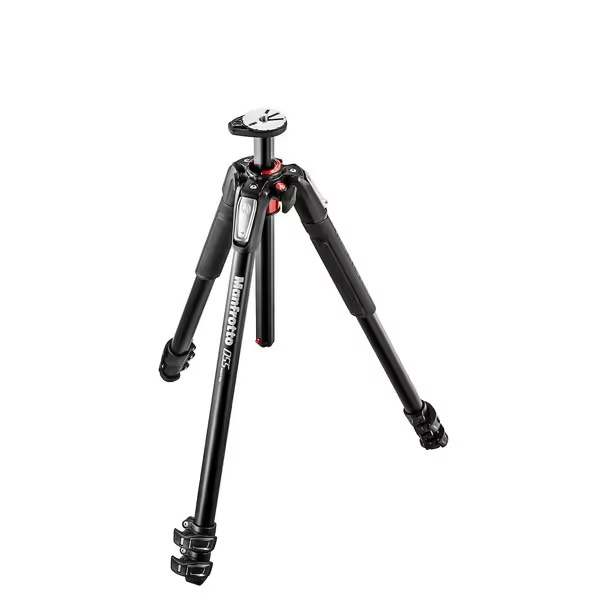
Manfrotto 3-Section Carbon Fiber Tripod MT055XPRO3
Versatile carbon fiber tripod for professional photography and content creation.
$219.99
MaterialCarbon Fiber
MaterialCarbon Fiber
Pros
90° column allows rapid vertical-to-horizontal camera switching.
Quick Lock system ensures rapid setup and extreme camera stability.
Magnesium body offers robustness and durability.
Cons
Weight receives mixed feedback; some desire lighter for travel.
Customers find this tripod to be of high quality, solidly built, and highly adjustable, with one customer noting it's stable with longer lenses. Moreover, they consider it well worth the price. However, the weight receives mixed feedback - while some find it not too heavy, others wish it was lighter. Durability and lockability are also mixed aspects, with some customers reporting it lasts many years while others mention it breaking after two months of use, and while the locking levers are secure, the column is not very secure.
Customers find this tripod to be of high quality, solidly built, and highly adjustable, with one customer noting it's stable with longer lenses. Moreover, they consider it well worth the price. However, the weight receives mixed feedback - while some find it not too heavy, others wish it was lighter. Durability and lockability are also mixed aspects, with some customers reporting it lasts many years while others mention it breaking after two months of use, and while the locking levers are secure, the column is not very secure.
Q: Do heavier tripods always resist wind better?
A: Not if damping is poor. Mass increases inertia, prolonging vibration decay. Consider this field data:
| Setup | Weight | 1/e Decay Time | Stability-per-Ounce |
|---|---|---|---|
| Aluminum tripod + 1kg load | 5.1 lb | 2.3 sec | 2.22 |
| Carbon tripod + 1kg load | 3.4 lb | 1.4 sec | 2.43 |
The lighter system had 9% better stability-per-ounce despite lower stiffness. Wind gusts transfer energy proportional to your setup's frontal area, not weight. A tall, narrow aluminum tripod may deflect less initially (higher stiffness), but without damping to absorb energy, oscillations persist. This is why vibration reduction techniques focusing solely on mass (like hanging camera bags) often backfire, because adding mass without damping increases decay time. If you do add weight, follow our counterweighting in real wind guide to avoid making vibrations worse.
Q: How can I test damping before buying?
A: Skip load ratings. Do this 60-second field test:
- Extend tripod to your true height (eye level without center column on flat ground).
- Mount your heaviest camera/lens combo.
- Gently tap the head sideways.
- Time oscillation decay with a stopwatch app until movement stops.
Pass: Decay under 1.5 seconds with 200mm+ lens. Fail: Movement visible after 2 seconds.
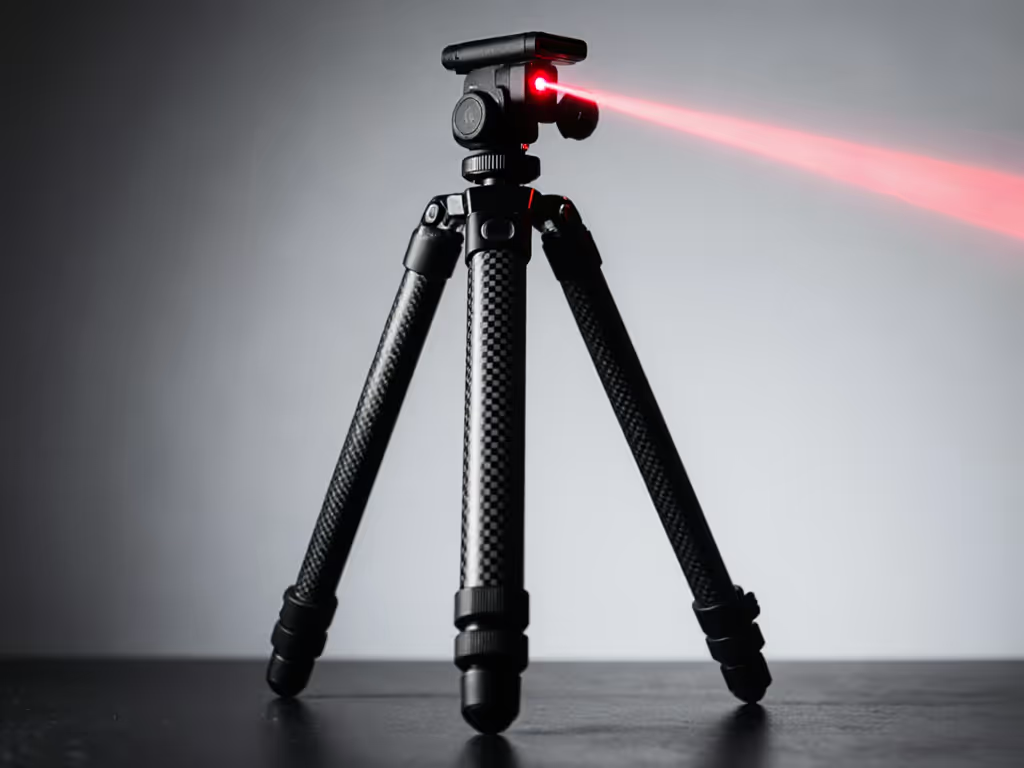
For precision: Shine a laser pointer at a distant rock. Count oscillations until the dot stabilizes. Critical damping requires ≤ 3 full cycles. To see how leg sections change vibration decay, read our 3-section vs 4-section stability test. If it rings like a bell, walk away, no matter the "50 lb capacity" claim.
The Real Metric You Should Demand
Manufacturers hide behind stiffness numbers (Nm/rad), but damping constants (Nms/rad) are your wind insurance. Why? Vibration reduction techniques that ignore damping fail when it counts:
- Rubber feet only help on hard surfaces, they worsen damping on sand/rock by isolating the tripod from energy-dissipating ground contact.
- Leg spread matters more than material: 25° leg angles amplify column vibrations 4x vs. 88° splay (per torque leverage physics).
- Head tightness over-dampens pans but under-damps vertical oscillations, find the sweet spot where head movement feels "dampened" but not sticky.
Until brands publish decay time data, judge tripods by how fast your specific rig stabilizes in wind. That sea cliff taught me: a 0.3-second decay advantage at 60 inches true height turned 30% keeper rates into 90%. That's stability-per-ounce in action.
Your next steps? Measure decay time on your current tripod at true height. If it exceeds 2 seconds with your telephoto, you're leaving sharpness on the table. Demand specs that reflect reality, not windless lab conditions. Because if stability isn't proven at your height in wind, the spec sheet is irrelevant.
Related Articles